Thursday, May 31, 2012

First Step: Fibers

The sustainability issues influenced by a garment's material include the full gamut of impacts: climate change; adverse effects on water and its cycles; chemical pollution; loss of biodiversity; overuse and misuse of non-renewable resources; waste production; negative impacts on human health; and damaging social effects on producer communities. 
Ch. 1 Sustainable Fashion and Textiles, Kate Fletcher 

Changing the materials that we use to make our garments is the first step in sustainable innovation. It is a relatively quick and easy change to make, and the benefits can be felt very quickly. It is a good first step, yet it cannot be the only step to sustainability. 

Lyocell - cellulose fiber from wood pulp
Fibers and materials for garments can be sustainable in a few different ways: they might be made from resources that are easily renewable; made from materials that do not require a lot of water, energy and chemicals to be produced; made by recycling or up-cycling waste; or made from materials that can biodegrade after their life cycle is complete. However, there are trade offs between these characteristics. For example bamboo is a very renewable resource, however it takes a lot of chemicals and energy to break it down to a fiber that can be used for clothing. So in the end it is not the best sustainable material. 

One fiber that has gained a lot of popularity lately is Lyocell (brand name Tencel). It is fiber produced from cellulose from wood pulp. The fiber can be generated without much energy and waste, and it is naturally a light color that takes well to dyeing (so no bleaching is required). Typically the wood pulp comes from eucalyptus trees which regrow relatively quickly. From what I've heard Lyocell is the closest we've found to a truly sustainable fiber, and luckily it makes a nice fabric, and can easily be blended with other fabric types. 

Recycled Polyester is another fabric that seems like it has a bright future. Amazingly we have found a way to turn plastic bottles into a fiber that can be used for clothing. Taking a waste product like plastic bottles and giving it new life in a garment is a great way to reduce impact. 


There has also been a lot of talk about biodegradable fabrics. If we were able to compost our clothing waste and return it to the natural cycle, it could reduce a lot of waste, and create a cradle-to-cradle scenario. However, Fletcher brings up an interesting point about creating bio-degradable garments. 

...from an energy perspective, electing to compost a garment rather than to recycle it... actually wastes the majority of energy embodied in the garment ... for it converts a complex, high-energy product (a garment) directly into a low-energy product (compost) without attempting to extract higher value first. 

Essential she's saying that we are wasting the potential in a garment if we choose to compost it rather than use it in another way. The amount of energy that is put into a garment should be used to its full extent before a garment is returned to the natural cycle. I personally wonder if a garment designed to biodegrade would be strong enough to have a long life as a piece in my wardrobe. How do you design something to fall apart, but last long enough to be used?

Then of course there is still a lot of discussion and interest in organic cotton. Cotton has always been the "fabric of our lives," but quite frankly I think it's on its way out. Cotton is too susceptible to pests and need too much water to ever really be sustainable. Organic cotton is produced under better conditions, but since less pesticides and chemicals are used, not all of the crop's full potential is realized. This (in my opinion) makes it not sustainable. If you put the time and money into a crop that doesn't yield enough in the end, then that to me is a waste. However as of now, the world relies on cotton too much, so I understand why organic cotton is preferable to standard cotton. 

When it comes to fibers there are so many different components to consider. There are a lot of new experimental fibers being created, such as fibers made from proteins such as milk or soy; fibers made from other plants like hemp, jute, and corn; and ever crazier sounding fibers like silk made from spider-webs. Choosing the right fiber seems like the first important step in overall change, but it's not entirely clear which fibers are the best when you consider all the angles. 

Tuesday, May 29, 2012

Zero Waste

Our first class project is to create a "zero waste" garment. As stated in my last post, about 15% of fabric is typically wasted during the production of a garment. Zero Waste is about using a whole piece of fabric for one garment so that there is no waste in the end. Not a single scrap of fabric should be on the sewing room floor when all is said and done. In order to accomplish this, one must rethink how to design the garment and how to lay out the pattern. It's sort of like a 2 dimensional puzzle that needs to reach a 3 dimensional reality, without missing a single puzzle piece.

 Prior to the industrial revolution, clothing and cloth were expensive and time-consuming products to make – and as a result fabric use and pattern forms were carefully manipulated to use as much of it as possible – often resulting in close to 100 percent yield (Burnham, 1973).
Shaping Sustainable fashion, ch 2. Holly McQuillan

Timo Rissanen's zero waste hoodie

Several designers have experimented with zero waste and there are many different ways to do it. Sometimes it starts from reversing the design process... by creating shapes on fabric and working within them to define the pattern pieces, and in turn lead to the final design. Other designers have use a jigsaw method which interlocks each pattern piece like a puzzle. Another option is to take one repeating shape, like a rectangle or triangle, and build a garment from those pieces. And finally, some designers just take the whole piece of fabric and drape it onto the form, manipulating the fabric into a wearable shape.


Timo Rissanen, Assistant Professor of Fashion Design and Sustainability at Parsons The New School for Design, and Holly Mcquillan, lecturer in the fashion design program at Massey University’s College of Creative Arts in Wellington NZ, were curators for a zero waste exhibition in 2011 called Yield.


I highly recommend that you take a look through the Yield collection: yieldexhibition.com/yieldexhibition-catalogue.pdf There are some amazing garments, and looking at the patterns is mind blowing. It's hard to understand how they were able to get from point A to point B.  You can tell that each designer used their own method to create their zero waste garment.

Can I turn this into a garment? :)
So now I'm faced with the same challenge. I've started with my Professor's suggestion of writing a word on my fabric and using it to define my pattern pieces. The word I've chosen is "Eco" ("sustainable" is a bit too long!). The very basic idea of what I'm starting with is pictured to the right. I've been experimenting and I have a few ideas, however I'm sure things will change as I progress. I'll share more of my process as I go, and hopefully I'll soon have a better idea of how I can make it work!


Monday, May 28, 2012

System Wide Sustainability

To start, here are a few interesting factoids from the first articles we read for class:
  • Worldwide more than 26 million people are employed in the clothing production business (it is an important component of the world's economy)
  • In 2011 H&M was the biggest user of certified organic cotton in the world (but I think it's deceiving because of their scale)
  • Garment producers typically waste 15% of the cloth needed to product one garment (in trimmings from how the pattern is laid out)
  • 5% of the world's population uses 25% of the world's energy resources (yes that's us)

Making a sustainable garment
Reflecting on ch. 2 Sustainable Fashion and Textiles, Kate Fletcher

Fletcher explains that the best practices in fiber and fabric processing are to cause the least amount of impact or to prevent impact from happening at all. To make a garment, there are many process to go through; from growing and harvesting the source of the fiber, to treating the raw fiber, to yarn manufacturing (spinning), to fabric manufacturing (weaving/knitting), and finally to product manufacturing (cut, sew, & trim). Throughout each of these processes harmful chemicals, water, and energy are used. The best practice is to minimize the number of processing steps, by using ‘cleaner’ processing techniques with ‘cleaner’ chemicals (less harmful), reducing energy and water consumption, and reducing waste.

The problem is that most of the time one company is responsible for just one step in the processes and then hands the garment over to another company who will do the next step. On an individual level there is no incentive for a company to spend more money to use ‘cleaner’ chemicals or make large changes in operations because the sustainability of the garment also relies on those other companies who may or may not be using sustainable practices.

While the whole systems improvement is widely recognized, it is little practiced because of the highly fragmented structure of the textile processing chain, typically involving a large number of small and medium size companies who tend to work on bringing change to processes that chiefly bring benefit to themselves.
Pg 43, Sustainable Fashion and Textiles, Fletcher

It seems the biggest problem in making a sustainable garment is to enact change throughout the supply chain. Each level of the supply chain must must change their practices so that the end result is sustainable. But the question is how to do this? With legislation and government enforced standards? Or should the initiative come from the fashion brand that is selling the product? I know that companies like C&A (Belgium), and Patagonia have taken it upon themselves to ensure that each level of garment production meets their sustainability standards. However it seems to me to be a complicated problem that will take a lot of work to solve on the larger scale. 

Thursday, May 24, 2012

Back in Green!

So it seems I've taken a bit of a hiatus from writing recently, but I'll be back in full force! I just started a summer course at MassArt called "Sustainable Fashion."  The course will dive into sustainable textiles, ethical and social responsibility, innovations in textile design and production, and other creative solutions that promote sustainability in the fashion industry. It will be a great chance for me to get a really in-depth look at sustainable fashion, and to work on some fun projects along the way.


Part of the course requirements are to record my thoughts and reflections on the readings and projects in the form of a journal/portfolio. I've chosen to record my thoughts through this blog!  So over the next few weeks you'll see a lot of posts related to the course. I hope that you will find them interesting and insightful.

******
However before I get into course related posts, here are a few bits and pieces that I've been meaning to share for a while...

    • I recently discovered a new website called Fashion Change:  http://fashioningchange.com/. It's just starting out, but their idea is to show you an eco-alternatives to popular fashions. They have this great concept called "wear this not that," which compares an eco-fashion item to am item from a popular brand. I also like this company because they explore all aspects of eco fashion from sustainable textiles, to fair trade, to up-cycling, recycling and zero waste. 
Great example of "wear this not that" from Fashion Change
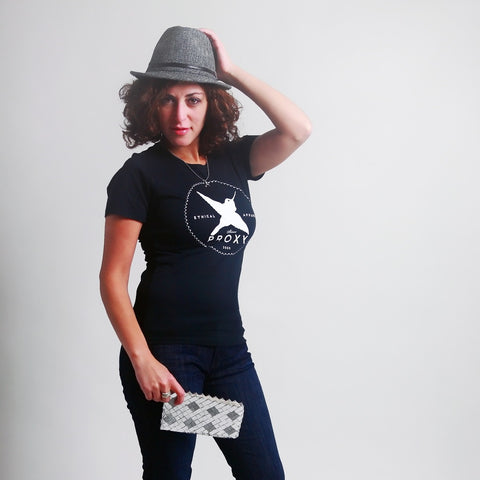
Proxy Apparel

Sunday, March 18, 2012

This week's eco-boutique - Amour Vert

Via eco fashion world, I stumbled upon a neat online boutique that specializes in sustainable fabrics. It's called Amour Vert, and they believe in fashion that is both beautiful and sustainable.

Amour Vert, uses natural and organic fabrics, is made in the USA, and pays attention to the factory conditions of its manufacturing partners. 

Orchidee Taupe - Peace Silk Dress
Their designs are simple and classic. Everything looks like something you could wear for years and years. The Orchidee Taupe Silk Dress is my favorite so far, and it's on sale for $64, which is not bad! Overall their prices are right around what I'm starting to expect for sustainable fashion. In general I'd consider it similar to the price range of Anthropologie. I can afford some things at full price, but usually I head straight to the sales rack. 

Aurelie Stripes
Amour Vert uses Organic Cotton, Bamboo, Peace Silk (silk that doesn't kill the silk worms), Tencel (wood pulp cellulose), Modal (birch tree cellulose), Soy, and Hemp fabrics. I think this is a good example of a brand focusing on a particular aspect of eco-fashion and doing it well. Amour Vert has chosen to go with the sustainable fabric route, and I love that they don't just have organic cotton. They are using many different types sustainable fabrics, so they can offer more interesting designs and options. I will definitely keep this shop in mind for future purchases! 

Wednesday, February 29, 2012

Green Oscars

I was delighted to discover that several stars were wearing "green" on the red carpet for this year's Oscars!

Livia Firth (Colin Firth's wife) has a fashion blog and is an advocate for eco-fashion. She's began the "Green Carpet Challenge" in 2009 when a friend challenged her to wear sustainable fashion to celebrity events. Livia herself has taken the challenge to heart, and for the Oscars this year she wore a sustainable Valentino gown designed especially for her. The fabric was made from silk and recycled plastic bottles.

Photo link from Livia's vogue fashion blog
In addition, Meryl Streep who was the winner for best actress also work a sustainable dress! Meryl wore an beautiful eco-certified gold Lavin gown.

Photo link from Livia's vogue fashion blog
Other celebs that wore eco-friendly fashion choices included Missi Pyle, who wore a sustainable gown from Red Carpet Green Dress contest winner, Valentina Delfino. The gown was lined with recycled polyester, made of silk peace chiffon, and included a sustainable zipper. I didn't even know there was such a thing as a sustainable zipper!

photo from ecology.com
Men were included in the sustainable fashion trend as well. Actors Kenneth Branagh, and Demian Bichir wore eco-friendly wool suits. And Livia's husband Colin Firth re-wore his Tom Ford suit from last year's Oscars. That more than anything else makes me happy. Re-wearing a suit from the year before is such a simple solution to create less waste. Plus when you have such a gorgeous suit, why not re-use it!

Friday, February 17, 2012

One Year Anniversary!


Happy one year of eco-friendly fashion to me! Exactly one year ago I wrote my first entry for this blog, oh the memories! I’m summing up my thoughts on my eco-year, and looking at how my perspectives have changed and what I think about the future of eco-fashion.


What I felt and what I learned
The eco-fashion rules I placed on myself this year have been both easy and hard to follow at the same time. I compare it to being on a diet: you’re doing it because you know it’s good for you, but every time you make the decision to have the salad instead of the french fries, you get a little sad. You stick to your diet to reach your goal, but you know deep down that you can’t do it forever.

The fist rule that I took to heart was buying less clothing. This is probably the hardest rule, but also the most important. By taking a step back and asking “do I need this?” before making a purchase, it really is possible to cut back on wasteful purchases.  I taught myself to be able to look at a beautiful dress, check the label, see that it was made in China and/or non-organic, and then put it back down without trying it on. Sometimes it was so hard!  

Buying organic clothing was extremely difficult. Besides the Hempest on Newbury I didn’t find any physical stores that sold organic or sustainable clothing. There are a lot of small shops on the internet that sell fashionable clothing made of sustainable fabrics, but it is tricky to find them. I also hate buying clothes online since you can’t try them on first. So all things considered, didn't buy very much clothing that fit into this rule.  

I would say the easiest rule for me was buying second-hand clothing. It’s cheap, there are a lot of second-hand shops in Boston, and you can find interesting things. The only downside is that second-hand clothes are always a little worn. It just can’t compare to buying a new item. After wearing a lot of second-hand clothing I felt dingy and was dying to buy something new and fresh. I also think second-hand is usually not quite nice enough to wear to work.

I should have used the “buy nice, expensive, long lasting clothes” rule to buy my work clothes, but the truth is I’m cheap. Yep. I’m getting better at spending more for quality, I really am, but I still hesitate to spend a lot on a piece of clothing. I do find myself now, at the end of the journey, realizing that I need some nice, quality pieces for my work wardrobe. I will have to invest a little so that I can buy more professional pieces.

I didn’t sew enough of my own clothing this year. I was proud of the dress I made for my friend’s wedding, and I loved my Halloween costume, but I wish I had done more. It’s just really hard to find time to sit down at a sewing machine and create a garment from scratch. It’s something I need to work on, and I hope that with a little focused discipline I can start making more of my own clothes in the future.

In some ways I feel like I’m always re-using stuff I don’t want. Whether it’s making earrings from left over materials, reworking a unitard from middle school as a costume for my aerials show, or turning a dress I don’t wear into a skirt I wear all the time. I do see potential in things, and I try to make use of them instead of throwing them away. However, regarding my last rule, I didn’t get around to donating any clothing this year. I do have a bag of clothes in my closet that I’d like to bring to Goodwill. I’ll try to work on doing that in year two ;)

It was hardest to follow my rules when I needed to buy basic necessities like tights, socks, and underwear. For those kinds of items most of us have one brand we know and love and use all the time. It was difficult to start from scratch and find something eco-friendly. The other challenge was shoes. It’s great that we have a vegan shoe store in Porter (Sudo), however you can’t rely on one store alone. Shoes need to fit perfectly and they need to be the right style. My thought going forward on shoes is that quality is the way to go. When it comes to shoes, it really benefits to invest in a good pair.


How I'll approach fashion in the future
Overall it’s been both hard and easy to stick to my rules this year. I think I was able to do it because I had a short term goal to accomplish, but after going through this journey I've come to terms with the fact that I can’t live with the rules my whole life. 

Going forward I am still going to be very conscious of my clothing choices. I will try to stick to my rules whenever possible, and I will still stay away from fast fashion stores. I want to be a conscious consumer and think about where my clothing comes from and how it gets into my hands. 

My plan for the future is to find more small boutiques or designers (especially ones with sustainable fabrics) and buy from them whenever possible. When it comes to larger brands, if I buy from them I'll try to find ones that have green initiatives. They don't have to sell organic clothing, but if they are concerned about labor conditions or their carbon footprint, that's a good start. Finally, I’m going keep limiting the amount of clothing I buy. I've save a lot of money this past year by not going on shopping sprees once a month. I've proven to myself that having a lot clothing isn't really necessary. I can buy less overall, and instead spend a little more on each item - for more quality pieces. 

This journey has taught me a lot about the realities of living eco-fashionably. My conclusion is that right now it's not easy to incorporate eco-fashion into your wardrobe completely. When considering eco-fashion in the mainstream we need to be realistic. It won't change overnight and there is no magic solution. We need to start thinking about the impact of clothing and fashion, and try to make better choices in our personal lives, and then see where it goes...

I plan to still explore eco-fashion in this blog. I'd like to do more research about online stores and resources, and I'd like to look into new fabrics and new technologies. I also want to find out more about what's happening in eco-fashion throughout the world. And of course I'll continue to share my personal experiences as I go! 

Thanks for reading!